




.png)


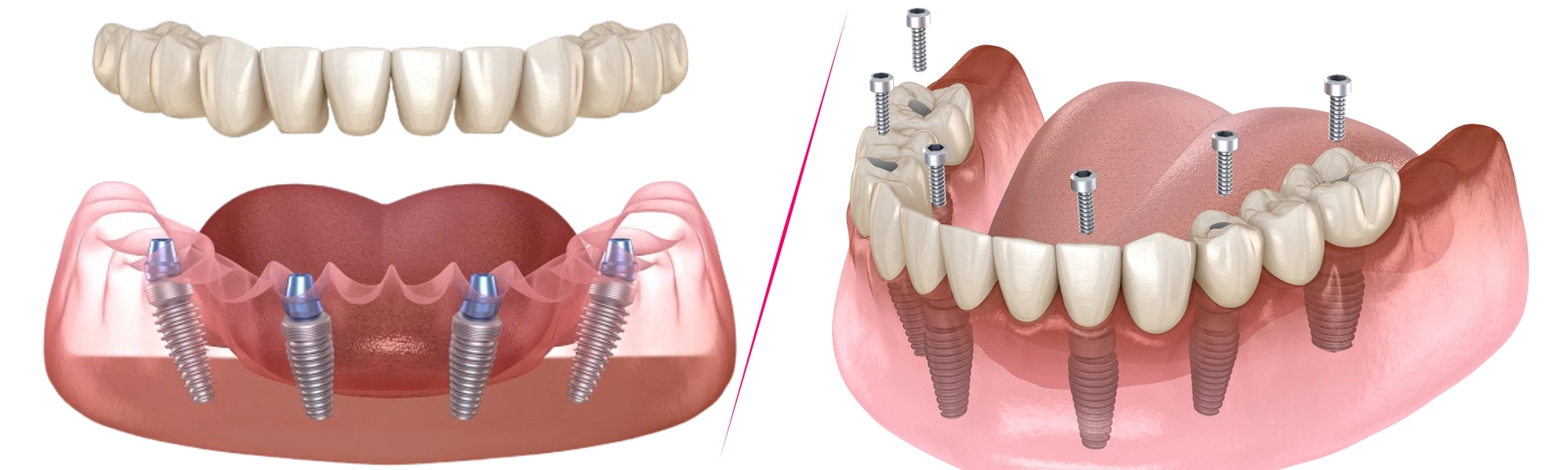
Full-arch dental implants have revolutionized the way patients restore multiple missing teeth — offering a fixed, functional, and aesthetically natural alternative to removable dentures. Over the last decade, Turkey has emerged as a global center of excellence for full-mouth rehabilitation, attracting patients from the UK, Germany, France, Italy, Spain, and the United States.
Whether a patient has lost several teeth due to decay, trauma, aging, or gum disease, two treatment options typically stand out:
✦ All-on-4 Dental Implants
✦ All-on-6 Dental Implants
Both procedures provide complete arch restoration — but they are not interchangeable. Choosing the right one requires understanding bone density, jaw structure, long-term durability, and patient goals.
This comprehensive guide explains everything you need to know — indications, biomechanics, surgical steps, advantages, disadvantages, timeline, cost comparison, and success rates — plus a full table comparison to help patients make a confident and informed decision.
What Are Full-Arch Implant Systems? (All-on-4 & All-on-6)
Full-arch implant systems represent one of the most advanced and transformative solutions in modern dentistry. Designed to replace an entire upper or lower dental arch, these systems use strategically placed titanium implants to support a complete set of fixed prosthetic teeth. Unlike traditional approaches, where each missing tooth requires an individual implant, full-arch systems allow 12–14 teeth to be replaced using just 4 or 6 implants — providing both efficiency and long-term durability.

The procedure begins with a thorough 3D CBCT scan of the jaw, which allows your dentist to evaluate bone density, jaw structure, and nerve location. Using this data, implants are positioned precisely to maximize support and minimize stress on the jawbone. In All-on-4 systems, the posterior implants are often angled to utilize available bone and avoid the need for bone grafting, while All-on-6 systems provide additional stability and bite strength, distributing chewing forces more evenly across the arch.
Key Benefits of Full-Arch Implant Systems
- Permanent, Non-Removable Teeth
Unlike dentures, which can shift or require adhesives, full-arch implants are permanently fixed in place. This allows patients to eat, speak, and smile naturally without fear of slipping or discomfort. - Natural Aesthetics
Prosthetic teeth are custom-designed for each patient, taking into account tooth shape, size, color, and alignment. The result is a symmetrical, white, and natural-looking smile that complements the facial structure and enhances overall appearance. - Restored Chewing Power
Full-arch implants provide nearly the same biting force as natural teeth, allowing patients to enjoy a wide range of foods — from crisp vegetables to lean meats — without restrictions. This is a major advantage over traditional dentures, which often limit diet and compromise nutrition. - Bone Preservation
One of the most significant advantages of full-arch implants is that they help maintain jawbone integrity. When teeth are missing, the underlying bone tends to resorb over time. Titanium implants stimulate the bone in the same way natural tooth roots do, preventing bone loss and maintaining facial structure. - Long-Term Reliability and Longevity
With proper care, full-arch implants can last decades or even a lifetime. Materials like medical-grade titanium implants and zirconia prosthetics ensure durability, biocompatibility, and resistance to wear and staining. - Reduced Surgical Complexity and Time
Compared to replacing each tooth individually, full-arch systems significantly reduce the number of implants needed, minimizing surgery time, recovery period, and overall cost. Many patients can even receive temporary teeth on the same day as implant placement, restoring both function and confidence immediately. - Confidence and Lifestyle Benefits
Patients regain the ability to speak clearly, eat without hesitation, and smile without self-consciousness. Beyond the functional benefits, full-arch implants improve quality of life, self-esteem, and social interactions, making them an ideal choice for anyone seeking a permanent solution for tooth loss.
What Makes Turkey a Global Leader in Full-Arch Dental Implants?
Turkey has become one of the most desired destinations for full-arch implant restorations for three major reasons:
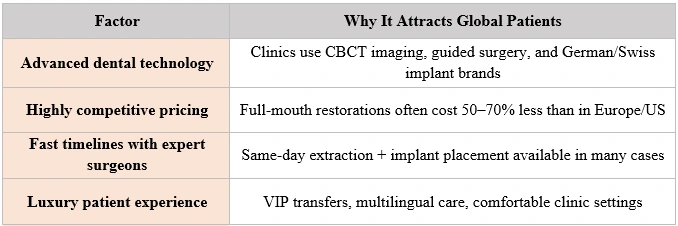
Patients receive high-precision dentistry with a premium hospitality experience — making Turkey one of the most trusted countries for full-arch implant rehabilitation.
What Is All-on-4 Dental Implant Treatment?
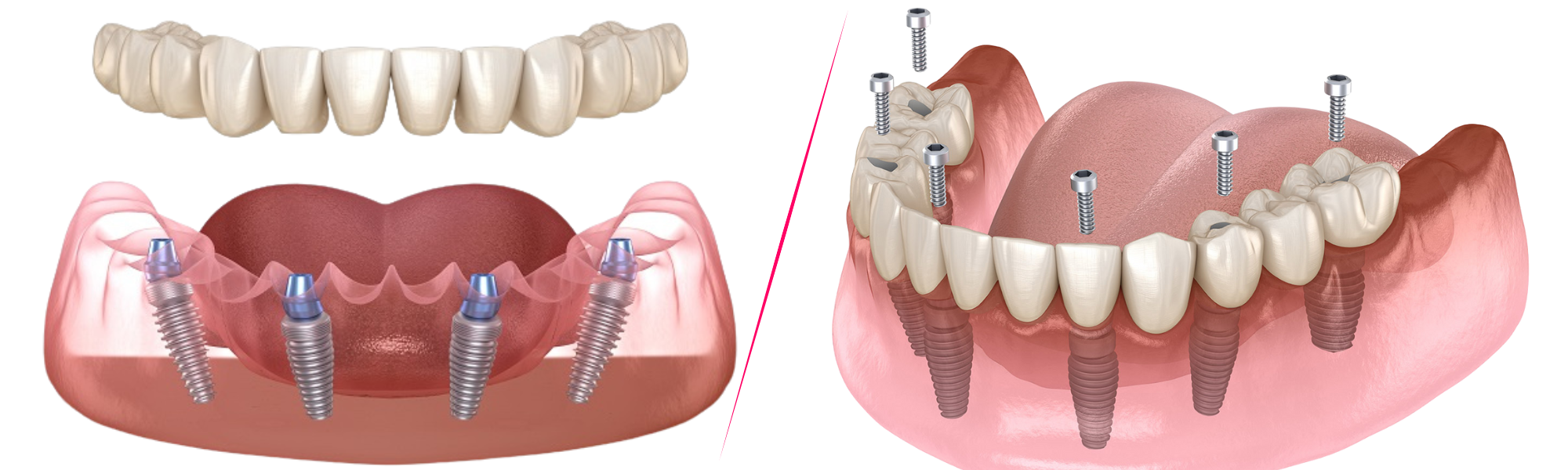
All-on-4 is a full-arch implant technique that uses four titanium implants to support a fixed prosthetic bridge.
Two implants are positioned vertically at the front of the jaw, while the other two are angled toward the back to maximize bone contact — allowing treatment even in cases of moderate bone resorption.
🦷 Best For:
✔ Patients with moderate bone loss
✔ Patients who want a faster, more affordable fixed solution
✔ Those who prefer minimal surgical intervention
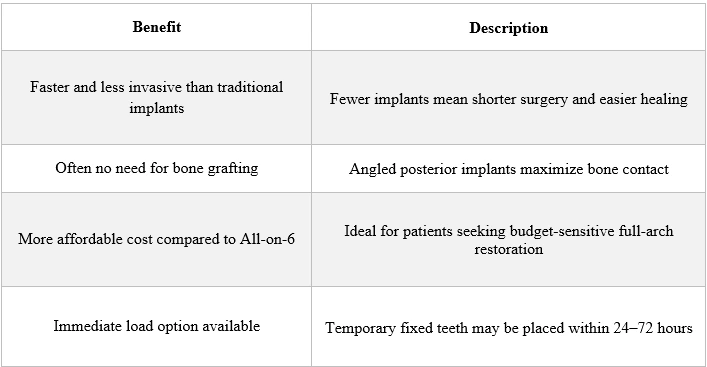
Advantages of All-on-4
Disadvantages of All-on-4
While highly successful, All-on-4 is not ideal for everyone.
- Less implant support compared to All-on-6
- Higher force load per implant
- Not recommended for patients with extreme bruxism (heavy grinding)
- Implant failure may compromise the entire prosthesis
What Is All-on-6 Dental Implant Treatment?
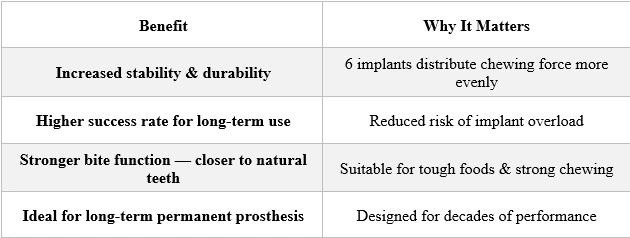
All-on-6 uses six dental implants instead of four, providing a stronger foundation and more even force distribution. It is ideal for patients with good bone density or those who want a more durable long-term restoration.
🦷 Best For:
✔ Patients with sufficient bone volume
✔ People needing maximum bite strength and longevity
✔ Younger patients looking for a lifetime solution
✔ Cases of full-mouth rehabilitation with high chewing force needs
Advantages of All-on-6
Disadvantages of All-on-6
- Slightly more expensive than All-on-4
- Bone grafting may be required in low bone density cases
- Surgery may take longer, with a longer healing period
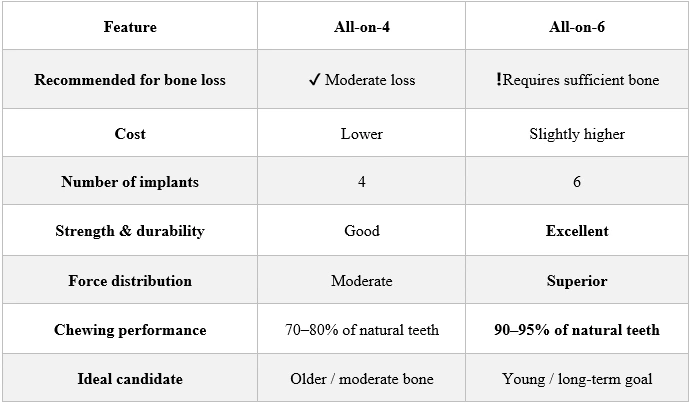
All-on-4 vs All-on-6 — Detailed Comparison Table
Treatment Timeline: What Patients Should Expect
Step 1: Consultation + 3D CBCT Scan
A full jaw scan evaluates bone density and determines whether All-on-4 or All-on-6 is more suitable.
Step 2: Tooth Extraction + Implant Placement
If remaining teeth are damaged, extraction occurs during the same session.
Step 3: Temporary Teeth (Same Day or 72 Hours Later)
Immediate functional aesthetics allow patients to smile confidently during healing.
Step 4: Final Prosthesis Placement (3–6 Months Later)
Once osseointegration is complete, permanent zirconia or nano-ceramic teeth are fitted with full precision.
Cost Comparison in Turkey vs Europe & USA

💡 Most patients save between 60–70% total treatment cost by choosing Turkey.
Which Should You Choose: All-on-4 or All-on-6?
🔸 Choose All-on-4 if you want:
✓ Lower price
✓ Faster healing
✓ Minimal bone structure
🔹 Choose All-on-6 if you need:
✓ Maximum chewing strength
✓ Lifetime long-term stability
✓ Higher durability under pressure
Frequently Asked Questions (FAQ)
Is All-on-6 always better than All-on-4?
Not always — it depends on bone density & long-term goals. Both treatments are highly successful.
How long do full-arch implants last?
20+ years on average, and many last a lifetime with proper care.
Does the procedure hurt?
Patients are typically treated under sedation or local anesthesia, ensuring comfort.
What materials are recommended for final teeth?
Zirconia and nano-ceramic restorations offer the most natural look and durability.
Can smokers receive implants?
Yes — but healing success is lower. Smoking reduction improves longevity significantly.
References
Albrektsson, T., & Sennerby, L. (2016). State of the art in oral implants. Journal of Clinical Periodontology.
Malo, P., de Araújo Nobre, M., Lopes, A. (2011). The “All-on-4” concept for edentulous jaws. Implant Dentistry.
Pjetursson, B. E., et al. (2018). Comparison of full-arch implant-supported prostheses. Clinical Oral Implants Research.
.png)
.png)



.png)


